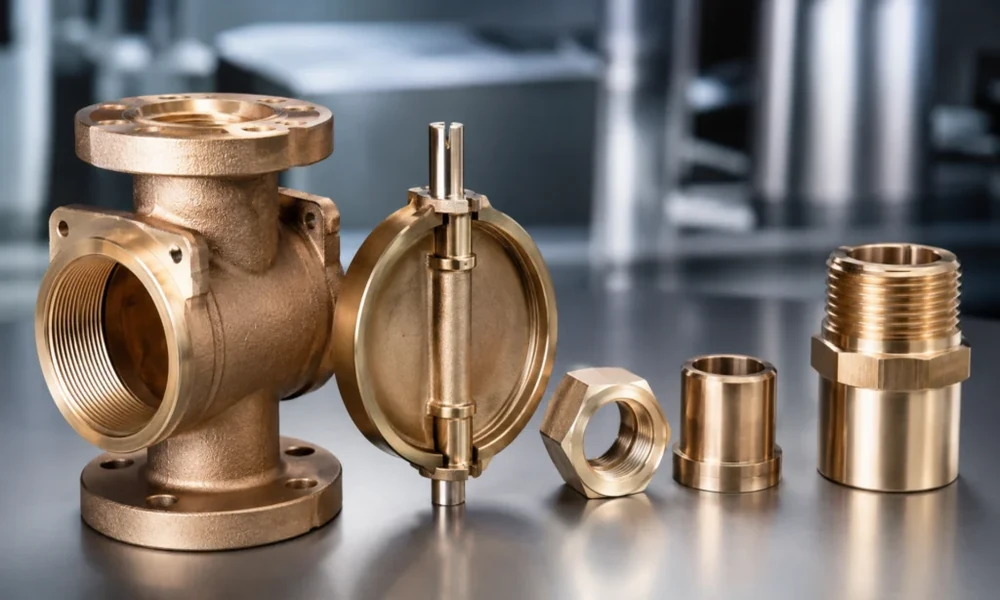
Look through any plumbing supply aisle, boiler room or marine hardware catalog and you will see the same warm yellow metal again and again. Brass has held its place in valves, fittings, couplings, locks and decorative hardware for generations, and a good brass casting company still has steady work even as plastics and stainless steel compete for the same jobs. The reasons are practical: brass casts well, machines quickly, resists many kinds of corrosion and looks good doing it.
Choosing brass is only the first decision, though. Alloy selection, lead content, casting method and the end use of the part all shape whether a casting performs as expected. Getting these factors right on the drawing prevents most of the costly rejections that show up at inspection.
What Makes Brass a Good Fit for Valves and Fittings?
Brass is a family of copper and zinc alloys, often with small additions of tin, lead, silicon, aluminum or bismuth. Molten brass is fluid enough to fill thin walls and fine threads, and it solidifies into pressure-tight bodies when the casting is properly fed. Those traits suit valve bodies, tees, elbows and manifold blocks, where internal passages and threaded ports need to be leak-free.
Machinability is the other big advantage. Brass cuts cleanly at high speeds with short chips, so threading, boring and seat finishing go quickly and tools last a long time. For high-volume fittings, faster machining often matters as much as the cost of the metal itself. Brass also offers good resistance to atmospheric and freshwater corrosion, natural resistance to biofouling thanks to its copper content, and an attractive finish that takes polishing and plating well for visible hardware.
How Do Lead-Free Rules Affect Brass Casting for Drinking Water?
For decades many brass alloys contained lead because it improves machinability and seals tiny shrinkage pores. That changed for potable water parts in the United States. The Reduction of Lead in Drinking Water Act, which took effect on January 4, 2014, lowered the allowed lead content in pipes, fittings and fixtures from 8 percent to a weighted average of 0.25 percent across wetted surfaces. Some items, such as parts used only for non-potable service, fall outside that rule.
NSF/ANSI/CAN 372 is the standard used to verify that weighted lead content, while NSF/ANSI/CAN 61 addresses what leaches from products into drinking water. Valve and fitting makers serving the potable market now use lead-free alloys that rely on silicon or bismuth to recover some of the machinability lead once provided. When you buy brass casting services for water system parts, state the end use plainly on the drawing and purchase order, and ask for chemistry certifications for every heat. A leaded alloy that is perfectly acceptable for a gas valve or a decorative escutcheon can be illegal in a kitchen faucet.
Which Brass and Bronze Alloys Are Common in Hardware and Industrial Parts?
Alloys are identified in North America by the Unified Numbering System, with cast copper alloys in the C80000 to C99999 range. A familiar example is C83600, a leaded red brass often called 85-5-5-5 for its nominal copper, tin, lead and zinc content. It has long been used for valves, flanges and pump parts outside potable water service.
Not every brass part is cast. C36000, known as free-cutting brass, is a wrought alloy supplied as bar and rod, and it remains a benchmark for machinability. Small fittings are often machined from it, while larger or more complex bodies are cast to save material and machining time. The decision usually comes down to part size, internal geometry and volume.
Bronze sits next to brass in many applications. C93200, often called bearing bronze or SAE 660, contains roughly 83 percent copper with about 7 percent each of tin and lead plus a few percent zinc. The lead helps it run against shafts with limited lubrication, which is why it shows up in bushings, thrust washers and wear plates. Custom bronze casting is common for parts like impellers, gear blanks and pump wear rings, where bronze offers better strength, wear performance or seawater resistance than ordinary brass.
When Is Centrifugal Casting Used for Brass and Bronze Parts?
Centrifugal casting pours molten metal into a spinning mold. The rotation throws the metal outward against the mold wall, where it solidifies from the outside in. Lighter impurities and gas move toward the inner bore, which is later machined away, leaving a dense, clean wall. The method suits round, hollow shapes such as bushings, sleeves, rings, liners and short tubes.
For bearing bronze and some brass components, that density translates into longer wear life and fewer porosity rejects after machining. A centrifugal casting company can usually produce blanks in a range of diameters and wall thicknesses that are then finished to size. For parts that are not round, such as valve bodies with offset ports, sand, permanent mold or investment casting remains the normal route.
How Do Brass Casting Supplies Affect Melt Quality?
Casting quality starts with the metal going into the furnace. Brass casting supplies include alloy ingot, returns from earlier pours, fluxes, degassing agents and crucibles. Foundries that buy ingot with certified chemistry and control how much scrap goes back into the melt have far fewer problems with stray elements. Contamination matters a great deal for lead-free work, because remelting old leaded scrap can push a heat out of specification.
Zinc also needs attention. It boils at a relatively low temperature, so overheating the melt burns off zinc and produces fumes, shifting the chemistry. In certain aggressive waters, some brasses suffer dezincification, where zinc leaches out and leaves a weak, porous copper structure. Dezincification-resistant alloys exist for those conditions, and buyers should mention water chemistry if it is known. Seawater and some chlorinated or low-pH supplies are the usual concerns, which is one reason bronze or specialized brass grades replace standard yellow brass in marine fittings.
Which Details Should Be Settled Before Placing a Brass Casting Order?
Start with alloy and end use: confirm the exact alloy designation, whether the part touches drinking water and which certifications must accompany each shipment. Ask how the foundry controls melt chemistry and scrap, which casting methods it runs and whether machining, pressure testing and finishing are handled in-house. Request sample inspection reports from similar valve or fitting work. A foundry that answers these points clearly, with records to back them up, is usually one that controls its process from melt to final test.