
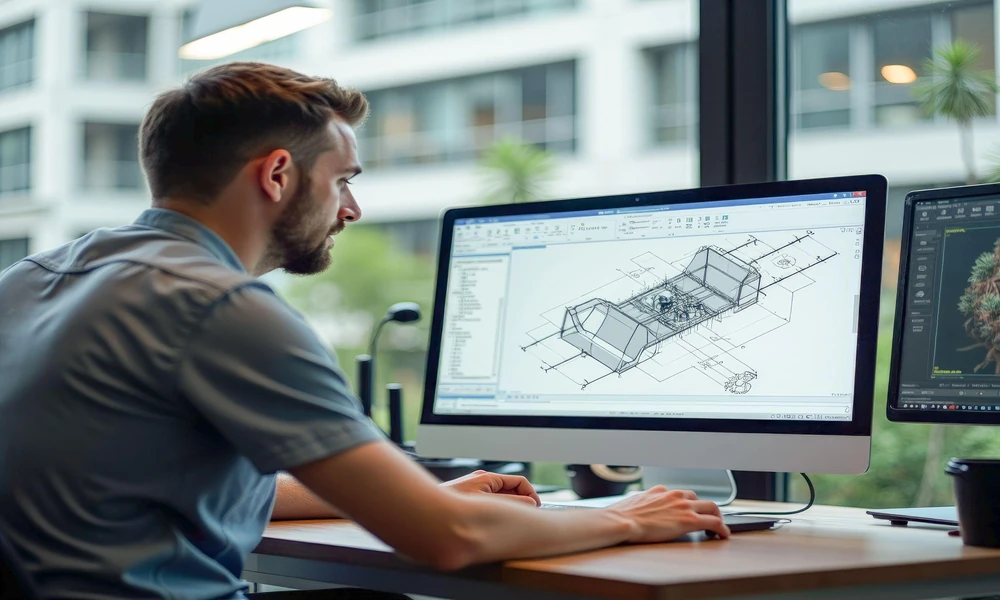
Image Recommendation: A US-based engineer reviewing a CAD drawing on a laptop beside a sample machined part, a world map with manufacturing sites marked faintly in the background.
Searching for nearby CNC services assumes proximity is the thing that actually solves a procurement problem. For a one-off prototype or a small repair job, it often is. For ongoing production volume, proximity tends to matter far less than capacity, consistency, and cost structure, which is a very different set of priorities than ‘closest shop that can machine this part.’
What ‘Nearby’ Actually Solves Well
1. Fast turnaround on a single prototype or a small batch where shipping time matters more than unit cost.
2. Easy in-person communication during an early design iteration phase.
3. Quick repairs or one-off replacement parts where volume was never the point.
What It Doesn’t Solve: Scaling Beyond a Prototype
A local shop that handled a prototype beautifully isn’t automatically positioned to handle the jump to production volume, since prototyping and volume manufacturing draw on different equipment, staffing, and cost structures entirely. This is usually the point where custom manufacturing services built around a hybrid model, US-based engineering and account support paired with established offshore production capacity, start to make more practical sense than continuing to search for a single domestic shop that can do it all.
Why the Hybrid Model Tends to Work Better at Volume
A hybrid arrangement keeps the parts of the relationship that benefit from proximity, design review, specification discussions, quality escalation, handled by a team that’s easy to reach and understands the local market, while production itself runs through facilities built specifically for consistent output at scale. This splits the problem into the two things it actually is: a communication problem, which proximity solves, and a manufacturing capacity problem, which it usually doesn’t.
What Gets Lost When the Decision Is Made on Proximity Alone
Choosing a supplier purely because they’re close by can mean locking into a facility whose capacity, pricing, and lead times were never actually built for the volume now being asked of them. The relationship often reveals its limits only once an order grows past what the shop was originally set up to handle, by which point switching suppliers mid-project carries its own cost and delay that a bit more upfront evaluation would have avoided.
Questions Worth Asking Before Choosing Either Path
1. Is this a one-off part or the start of an ongoing production run?
2. Does the volume being discussed actually fit a local shop’s typical capacity, or would it strain it?
3. How is quality verified and communicated across the full production run, not just the first sample?
How This Usually Unfolds Once a Decision Is Made
Moving from a prototype relationship to a structured manufacturing partnership typically starts with a design-for-manufacturability review, where an engineering team flags anything in the current design that would be costly or difficult to produce at volume. That conversation alone often surfaces changes worth making before tooling or production planning begins, which tends to save more time overall than skipping straight to a quote.
What a Genuine Manufacturing Partner Actually Offers
The appeal of nearby CNC services makes sense for the right kind of job. For anything beyond that, the more useful question becomes whether a manufacturing partner has the engineering support to work with a US-based team closely, alongside the actual production capacity to deliver consistent volume once a design moves past the prototype stage.
What a US-Facing Account Team Should Actually Provide
- Direct, timezone-friendly access to engineering support during design and specification discussions.
- Clear visibility into where production is actually happening and how quality gets verified there.
- A single point of accountability, rather than needing to coordinate separately with an overseas factory.
What This Looks Like Once Volume Actually Ramps Up
Once a program moves into steady production, the questions that mattered most during sourcing, who’s answering calls locally, who’s actually running the equipment, start to matter less than whether output stays consistent order after order. That consistency is what a structured partnership is built to deliver, and it’s generally a better measure of whether the original sourcing decision was the right one than how the first few conversations went.
Proximity was never really the goal. It was a proxy for easy communication and fast turnaround, and once a project moves past the prototype phase, those needs are usually better served by a structured partnership than by distance on a map.
Working out whether a project needs a local shop or a structured manufacturing partnership is easier with a direct conversation about the actual volume involved. Contact Disk Precision Group to talk it through.